Anti-Payload Antibodies
Why payload-bearing exposure can tell a different story from total antibody
An antibody–drug conjugate must remain stable while circulating, yet release its payload after reaching the intended biological environment. Release it too early, and systemic exposure to the free drug may increase while less payload reaches the tumour. Release it too late, and the ADC may reach its target without delivering an effective dose.
It’s an age-old question in biology research: It worked in vitro. It worked in vivo. But is the payload released where and when it is supposed to be?
When efficacy, toxicity, or pharmacokinetics do not behave as expected, the obvious question is: what happened to the payload?
The antibody can remain after the ADC has changed
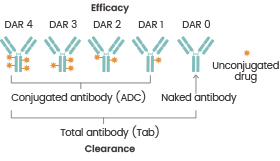
Following administration, an ADC can undergo payload loss, linker modification, and other biotransformations. An ADC typically shifts toward lower DAR species over time, and molecules that initially carry multiple payloads may progressively lose them until DAR 0 is reached. At DAR 0, the therapeutic antibody may still circulate and remain detectable
but it is no longer a conjugated antibody.
DOI: 10.1208/s12248-020-00475-8
A total-antibody assay cannot independently reveal this transition. It detects the therapeutic antibody whether it is fully loaded, partially loaded, or completely unloaded. A stable total-antibody curve therefore does not prove that payload-bearing ADC remains equally stable.
Measure the carrier and whether it still carries cargo
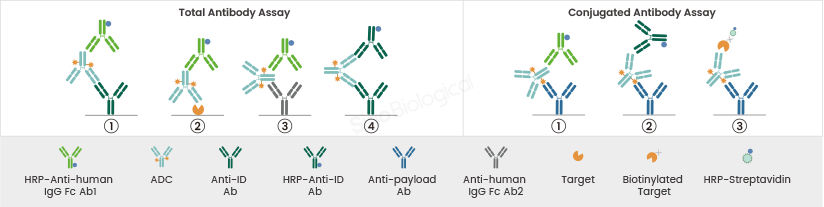
ADC developers can compare total antibody with conjugated antibody and free payload to reconstruct what is happening in vivo. Total antibody shows how much therapeutic antibody remains; conjugated antibody shows how much retains at least one detectable payload; and free-payload measurements help characterize systemic exposure after release.
The FDA recommends measuring an ADC and its relevant constituent parts using validated methods beginning with first-in-human studies.[1] Ligand-binding assays are commonly used for total and conjugated antibody, while LC–MS/MS is particularly useful for free payloads and metabolites.[2]
Reference: DOI: 10.3390/molecules27196299
Making payload-bearing ADC visible
A conjugated-antibody assay must recognize both the payload and the therapeutic antibody on the same molecular complex. An anti-payload antibody can capture the attached drug, while an anti-Fc, anti-idiotype, or target-based reagent confirms the antibody. Unloaded antibody lacks the payload required for capture; free payload lacks the antibody required to complete the assay.
This does not identify the precise mechanism or location of release, nor replace detailed DAR analysis. But if conjugated-antibody exposure declines faster than total-antibody exposure, it reveals that payload-bearing ADC is disappearing faster than the carrier alone.
Choose recognition matched to the payload
Because payloads differ structurally and chemically, there is no universal anti-payload antibody. Sino Biological offers ELISA-validated monoclonal antibodies recognizing DM1, Dxd/Exatecan, MMAE, MMAF, and SN38, with multiple species, clones, and selected biotinylated formats for different assay configurations.[3]
If total-antibody measurements tell you that the carrier remains, an anti-payload assay can help answer the next question: is it still carrying the drug?
Explore Sino Biological’s anti-payload antibodies to identify a reagent matched to your ADC payload and assay strategy.
Sino Biological. Anti-payload antibodies for ADC PK studies.
Featured Antibodies
| Target | Cat# | Product Name | Application |
| DM1 | 68254-MM07 | Anti-DM1 Antibody, Mouse MAb | ELISA |
| 68254-R0002 | Anti-DM1 Antibody, Rabbit MAb | ||
| Dxd/Exatecan | 68256-MM01 | Anti-Dxd/Exatecan Antibody, Mouse MAb | ELISA |
| 68256-MM06 | Anti-Dxd/Exatecan Antibody, Mouse MAb | ||
| 68256-MM08 | Anti-Dxd/Exatecan Antibody, Mouse MAb | ||
| 68256-R0009 | Anti-Dxd/Exatecan Antibody, Rabbit MAb | ||
| 68256-R0014 | Anti-Dxd/Exatecan Antibody, Rabbit MAb | ||
| 68256-MM01T-B | Anti-Dxd/Exatecan Antibody (Biotin), Mouse MAb | ||
| 68256-R0014-B | Anti-Dxd/Exatecan Antibody (Biotin), Rabbit MAb | ||
| MMAE | 68218-MM08 | Anti-MMAE Antibody, Mouse MAb | ELISA |
| 68218-MM08T-B | Anti-MMAE Antibody (Biotin), Mouse MAb | ||
| MMAF | 68219-MM01 | Anti-MMAF Antibody, Mouse MAb | ELISA |
| SN38 | 68255-R0007 | Anti-SN38 Antibody, Rabbit MAb | ELISA |
References
1. FDA. Clinical Pharmacology Considerations for ADCs (2024).
2. Qin Q et al. Current analytical strategies for ADCs in biomatrices (2022).
3. Sino Biological. Anti-payload antibodies for ADC PK studies.